



Table of Contents
Online education isn’t new anymore, but the way people use it is continuously changing.
If you’re thinking about launching an online course, building a membership site, or expanding an existing eLearning platform, keeping up with current online learning stats is one of the smartest things you can do. Not because numbers are exciting, but because they shape expectations: how people learn, what they’re willing to pay for, and what actually keeps them coming back.
In this article, we’ll look at the most relevant eLearning statistics for 2026, break them down by theme, and most importantly, explain what they mean in practice for educators, course creators, and online business owners.
Why Online Learning Statistics Matter More Than Ever
It’s easy to assume that “online learning is booming” and stop there. But that surface-level understanding can lead to poor decisions like overpriced courses, the wrong format, or platforms that don’t scale.
Current stats about online learning help answer questions like:
- Is the market still growing, or already saturated?
- Who is actually buying online courses today?
- Are people learning on desktop, mobile, or both?
- Do memberships still outperform one-off course sales?
- Which industries are leading?
When you understand the data behind learner behavior, you stop guessing and start planning. So let’s take them one by one.
1. Market Size & eLearning Growth in 2026
Let’s start with the big picture.
Based on the latest online learning stats, the global eLearning market is projected to continue expanding through 2026 driven by corporate, academic, and mobile learning adoption, with mobile use exceeding 60% in some regions.
What’s interesting isn’t just the size of the market, but why it’s growing:
- Companies are investing more in internal training;
- Professionals are continuously upskilling outside traditional education;
- Remote work has normalized online learning as a default option.
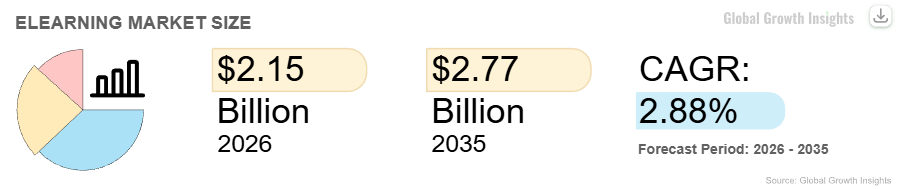
These eLearning growth statistics confirm that demand isn’t slowing down, but it’s becoming more specialized.
2. Online Learning Demographics: Who Is Actually Learning Online?
Understanding your audience is just as important as understanding the market.
Most online learners today aren’t traditional college-age students, instead, adult learners dominate the space, with large age groups between 25–34 and 35–44 representing the majority of participants in online courses and programs. These learners are often professionals looking to advance careers, upskill, or switch industries, and they increasingly choose online formats for convenience and career relevance.
At the same time, younger learners are increasingly comfortable learning online, especially when content is short, mobile-friendly, and easy to consume between other activities.

Geographically speaking, North America and Europe still lead in adoption, but some of the fastest growth comes from Asia-Pacific and Latin America. These regions are shaping the next wave of eLearning industry statistics.
3. Mobile Learning & Technology Adoption
One trend that shows up consistently across eLearning statistics is the shift toward mobile learning.
A large percentage of learners now expect to access courses on their phones, not just occasionally, but as their primary device. That’s why:
- Short lessons perform better than hour-long videos;
- Microlearning formats keep engagement higher;
- Responsive platforms are no longer optional.
At the same time, AI and automation are becoming more common behind the scenes. Personalized recommendations, adaptive learning paths, and automated emails all contribute to better learner experiences.
4. Revenue & Monetization: What Actually Works
One of the most common questions we hear is whether online courses are still profitable. The data says yes, but how you sell matters.
Global online learning revenue is expected to continue rising into 2026 and beyond, with projections showing substantial gains across platforms, university education, and professional certifications.
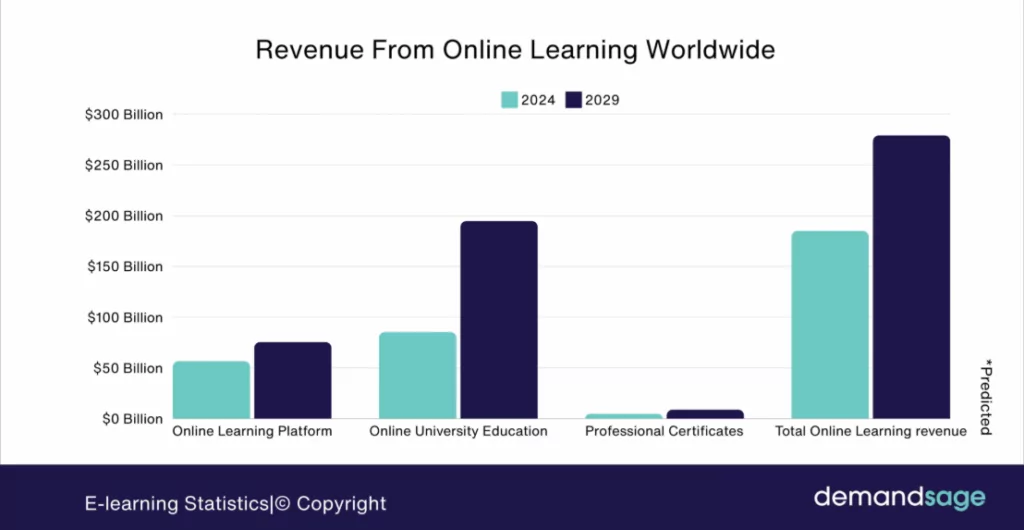
Instead of one big purchase, learners increasingly prefer ongoing access, especially when learning is tied to community, updates, or professional development.
5. High-Demand Industries in Online Learning
Beyond overall growth, the more practical question is: what are people actually willing to pay to learn?
Recent industry reports show that demand consistently centers around skills that improve career prospects, income potential, or overall well-being.
Tech and digital innovation stands out clearly. The World Economic Forum’s Future of Jobs Report 2025 shows that roles tied to technology, especially AI, data, and cybersecurity, are among the fastest-growing areas of skill demand as employers reshape work for the next decade.
Business, digital marketing, and growth skills also remain strong. Trends from the Coursera Global Skills Report 2025 highlight rising enrollments in business, data, and technology disciplines with micro-credentials and skills like cybersecurity and business analytics becoming increasingly important to learners globally.

Alongside technical skills, career development and workplace learning continue to attract investment. The LinkedIn Workplace Learning Report 2025 indicates that employers and professionals alike are focused on upskilling and continuous learning as part of career growth and organizational adaptability.
Outside strictly professional topics, health, wellness, and lifestyle education remain major areas of consumer interest. According to the Global Wellness Economy Monitor 2025, the global wellness economy, which includes fitness, nutrition, mental well-being, and prevention, is a multitrillion-dollar market that continues to expand, suggesting ongoing interest in related online education and coaching formats.
Across these reports, the pattern is consistent: learners are most willing to invest in knowledge that helps them advance careers, adapt to technological change, or improve health and life outcomes.
You don’t need to teach in all these areas to succeed — but aligning your course with where demand is already strong can give you a strategic edge.
Turning Insights Into Action: What Can You Do About It?
Reading through all these online learning statistics, one thing becomes clear: the opportunity is real.
If you’ve ever thought about launching an online course, building a learning platform, or turning your expertise into a digital product, the data above can help you make a more informed decision about how to approach it.
Instead of asking, “Should I start?”, a better question might be: “Given how the market is evolving, what’s the smartest way to start?”.
For example:
- If adult learners between 25–45 dominate online education, your messaging, pricing, and course format should reflect their needs: practical, career-focused, flexible;
- If mobile learning continues to rise, your platform and lessons must be optimized for smaller screens and shorter sessions;
- If recurring revenue models outperform one-time purchases, you might want to explore memberships instead of standalone courses;
- If certain industries (ex. tech, digital marketing, business skills, AI, personal development) show consistent demand, positioning your course within high-growth niches could improve your chances of success.
The statistics don’t just describe the market, but help you decide where and how to enter it.
And once you’ve clarified your direction, the next step is simple: you need the right tools to build it. WordPress is one of your safest bets when it comes to ease of use and flexibility, since it comes with a plethora of plugins to extend your website’s functionality.
When it comes to online courses, plugins like Paid Member Subscriptions make it a breeze to build structured, membership-based learning platforms that you can easily monetize. By integrating with tools like LearnDash or Tutor LMS, you can create and sell courses to earn recurring revenue from your subscribers.

Paid Member Subscriptions Pro
Accept (recurring) payments, create subscription plans and restrict content on your website. Easily setup a WordPress membership site using Paid Member Subscriptions.
Get Paid Member SubscriptionsIf you’re not sure where to start on the implementation side, we’ve already put together practical guides that walk you through different approaches to building courses with WordPress:
- How to create and sell online courses with WordPress
- How to build video-based courses
- How to sell courses with WooCommerce
- Recommended WordPress LMS themes for online learning platforms
Final Thoughts: What the 2026 eLearning Landscape Tells Us
Online education isn’t slowing down; it’s maturing. Learners are more selective, more mobile, and more focused on practical outcomes than ever before.
Taking all the stats into consideration, here’s a short checklist to keep in mind if you’re building an online course or platform in 2026:
- Getting started is still worth it, as the market continues to grow and specialize.
- Focus on learners aged 25–45, as they represent the strongest spending segment in self-development and professional upskilling.
- Consider high-demand industries like tech, digital marketing, business skills, AI, or personal development.
- Optimize for mobile-first learning: short lessons and responsive platforms are no longer optional.
- Think beyond one-time sales. Memberships and recurring access models increasingly drive long-term revenue.
- Prioritize practical, outcome-driven content over theoretical information.
So, to put it shortly: if you combine clear positioning, the right format, and the right tools, building a successful online learning platform in 2026 is not only possible, but realistic.
Related Articles
How To Create a Divi Membership Site
If you’re thinking of building a membership site in WordPress, you’ll need a solid theme and a membership plugin that pairs well with it. In this complete guide, we’ll show you how to create a Divi membership site using the popular Divi theme in combination with the Paid Member Subscriptions plugin.
Continue Reading
How to Hide Products by User Roles in WooCommerce?
Do you want to easily hide products by user roles in WooCommerce? Some WooCommerce store owners have a unique requirement where they want to hide certain products from all but a few specific groups of users. There may be many reasons for this, including selling exclusive products only to the more loyal customers, with a […]
Continue Reading
How to Create WordPress Redirects to Another Page, External URLs, or a Subdomain
There are different reasons WordPress site owners want to create WordPress redirects to another page, external URL, or a subdomain. The redirect can be based on an important user action or set up to redirect all users landing on a particular page. Whatever the type or need of your redirect, WordPress offers the flexibility to […]
Continue Reading